Marty Supreme Review: Timothée Chalamet Unleashed

In the dizzying, frenetic world of Marty Supreme, directed by the Safdie brothers, we are introduced to a young man whose singular obsession with becoming a global table tennis superstar propels him on a wild, unrelenting journey. Timothée Chalamet delivers a tour-de-force performance as Martin Mauser, a narcissistic, egotistical hustler who will stop at nothing to achieve his dream, even if it means manipulating, deceiving, and exploiting everyone in his path.
Based loosely on the real-life story of Marty Riseman, a table tennis player in 1950s America, Marty Supreme is a bold, unapologetic exploration of the American Dream and the lengths one will go to in pursuit of fame and fortune. As Martin careens from one outrageous scheme to the next, the film becomes a dizzying, adrenaline-fueled ride, propelled by a pulsing 1980s soundtrack that perfectly captures the manic energy of its protagonist.
A Virtuosic Performance and a Daring Directorial Vision
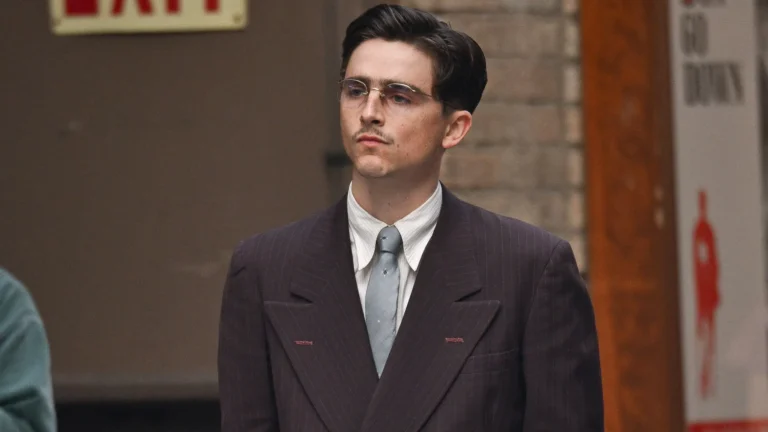
At the heart of Marty Supreme is Chalamet’s electrifying performance, which has been widely praised as one of the best of his career. The young actor seamlessly inhabits the role of Martin, imbuing the character with a frenetic, manic energy that never lets up. From his lightning-fast table tennis skills to his relentless scheming and manipulation, Chalamet’s Martin is a force of nature, a whirlwind of ambition and self-delusion that threatens to consume everything in its path.
But Chalamet’s tour-de-force is matched by the Safdie brothers’ daring directorial vision. Josh and Benny Safdie, the acclaimed filmmakers behind Good Time and Uncut Gems, have crafted a cinematic experience that is as visually stunning as it is narratively compelling. The film’s frenetic pacing, kinetic camerawork, and immersive sound design all work in concert to transport the viewer into Martin’s chaotic, high-stakes world.
Interestingly, the Safdies have chosen to score the film with a soundtrack of 1980s pop hits, a decision that adds an additional layer of meaning to the story. As Martin navigates the cutthroat world of table tennis, the music of the Reagan era serves as a thematic backdrop, underscoring the film’s exploration of the American Dream and the relentless pursuit of wealth and status.
A Tangled Web of Relationships and Obstacles
At the center of Marty Supreme is Martin’s tangled web of relationships, each one a potential obstacle or opportunity in his quest for glory. From his childhood sweetheart, Rachel (Odessa A’zion), whom he accidentally impregnates in the film’s opening moments, to the retired movie star, Lillian Mayhew (Gwyneth Paltrow), whom he sets his sights on seducing, Martin’s life is a constant juggling act of manipulation and deception.
One of the most compelling relationships in the film is that between Martin and his former table tennis champion mentor, Rolf Haber (Géza Röhrig), a Holocaust survivor who serves as both a father figure and a rival to the young upstart. Their dynamic is a complex one, marked by both admiration and resentment, as Martin seeks to surpass his mentor’s achievements while also relying on his guidance and expertise.
Another key figure in Martin’s life is the formidable Japanese table tennis champion, Koji Fujiyama (Koto Kawaguchi), who serves as the film’s primary antagonist. Deaf and mute, Fujiyama is a silent, brooding presence, his mastery of the sport a constant reminder of Martin’s own limitations and the steep climb he faces to achieve his dreams.
Martin’s childhood sweetheart, Rachel, whom he accidentally impregnates in the film’s opening moments
Rolf Haber, Martin’s former table tennis champion mentor and a Holocaust survivor
Koji Fujiyama, the formidable Japanese table tennis champion who serves as the film’s primary antagonist
Lillian Mayhew, the retired movie star whom Martin sets his sights on seducing
Exploring the American Dream and the Diasporic Jewish Experience
At its core, Marty Supreme is a film about the pursuit of the American Dream, and the lengths to which one will go to achieve it. Martin’s single-minded focus on becoming a table tennis champion is a metaphor for the relentless ambition that has long been a hallmark of the American experience, particularly for marginalized communities seeking to carve out a place for themselves in a society that often denies them opportunity.
The film’s exploration of the diasporic Jewish experience is particularly poignant, as Martin’s story is loosely inspired by that of Marty Riseman, a real-life table tennis player whose own journey mirrored the struggles and aspirations of many Jewish Americans in the post-Holocaust era. The film’s setting in the early 1950s, just a few years after the end of World War II, adds an additional layer of significance, as Martin’s pursuit of glory can be seen as a rejection of the trauma and displacement that his community has endured.
Interestingly, the film’s use of 1980s music, a decade often associated with the excesses of the Reagan era, serves to further underscore the film’s thematic concerns. The 1980s, a time of unbridled ambition and the pursuit of wealth and status, provides a fitting backdrop for Martin’s own relentless drive to achieve his dreams, no matter the cost.
A Virtuosic Blend of Style and Substance
Ultimately, Marty Supreme is a cinematic tour de force, a virtuosic blend of style and substance that firmly establishes the Safdie brothers as two of the most exciting and innovative filmmakers working today. Chalamet’s electrifying performance, coupled with the Safdies’ daring directorial vision, creates a film that is both visually stunning and thematically rich, a dizzying exploration of ambition, deception, and the enduring power of the American Dream.
For those interested in exploring the world of Marty Supreme further, be sure to check out the film’s official website, where you can find information on showtimes and ticket purchases.
So whether you’re a fan of the Safdie brothers’ unique cinematic vision, a devotee of Timothée Chalamet’s captivating performances, or simply someone who appreciates a well-crafted, thematically rich film, « Marty Supreme » is a must-see experience that is sure to leave a lasting impression.













Laisser un commentaire