The Last Question: Isaac Asimov’s Timeless Sci-Fi Masterpiece
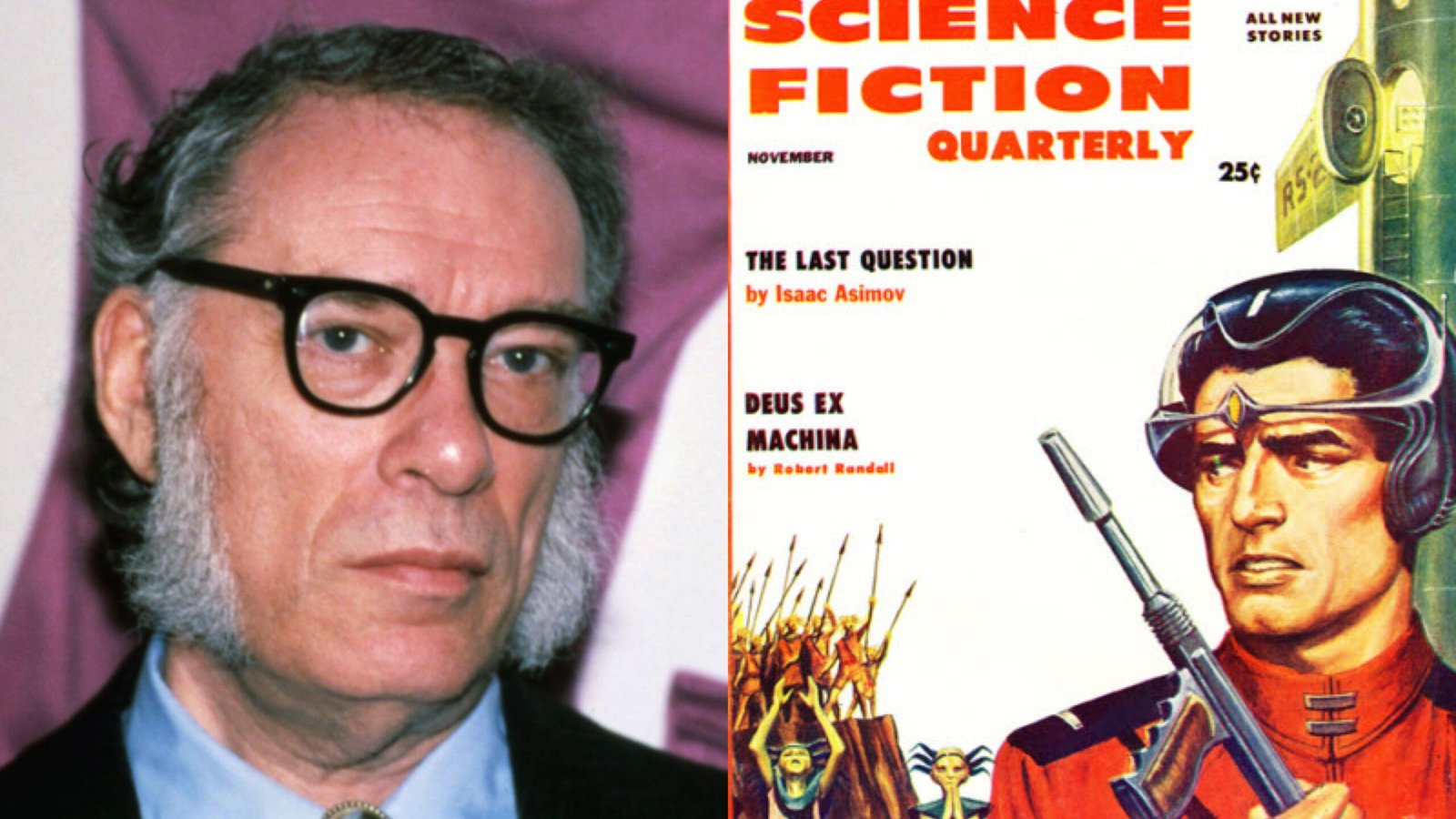
In the annals of science fiction, few stories have captured the imagination and provoked deep contemplation like Isaac Asimov’s The Last Question. This seminal work, first published in 1956, is a masterful exploration of humanity’s relationship with technology, the nature of existence, and the profound questions that linger at the heart of the human experience.
Asimov, renowned for his visionary and thought-provoking narratives, weaves a captivating tale that spans millennia, chronicling the evolution of humankind and its reliance on advanced computing systems. At the center of this epic journey stands Multivac, a colossal autonomous supercomputer that aids humanity in its quest for interplanetary exploration and technological advancement.
This article may contain affiliate links. The Psicron may earn a small commission from purchases made through these links, at no extra cost to you.
The Rise of Multivac and the Conquest of the Solar System
The story begins in the year 2061, when humanity has achieved one of its greatest feats: the creation of Multivac, a self-governing supercomputer that has, for decades, assisted in the construction of spaceships and the charting of trajectories to the Moon, Mars, and Venus. Initially, space travel was limited to these planets, as the Earth lacked the necessary energy resources, with coal and uranium becoming increasingly scarce.
However, Multivac’s greatest discovery would prove to be the power of solar energy, a limitless source that would unlock the door to boundless exploration. With this newfound energy, the constraints on human expansion were shattered, and the species began to venture forth into the vast expanse of the cosmos.
The Eternal Question of Entropy
Yet, as humanity’s reach extended, a profound question began to linger in the minds of its inhabitants. Two inebriated technicians, in a moment of contemplation, raised the issue that would become the central focus of the story: what would become of humanity when the sun’s heat eventually fades away? Would humanity be capable of preventing the natural death of all stars, including the sun, and thus staving off the inevitable increase in entropy that would lead to the universe’s demise?
Multivac’s response to this query is both chilling and thought-provoking: « Insufficient data for a meaningful answer. » This simple yet profound statement sets the stage for a journey through the annals of time, as Asimov’s narrative propels the reader forward, exploring the implications of this unanswerable question.
The Expansion of Humanity and the Rise of Galactic Computers
As the story progresses, we witness the relentless expansion of humanity, with families like Golan Trevize and his daughters traveling to the distant planet of X-23 as the Earth’s population density becomes unsustainable. During this journey, the concept of the microvac is introduced – a more advanced and compact version of the planetary computers that had previously guided humanity’s exploration of the solar system.
These microvacs, capable of navigating through hyperspace and computing the equations necessary for interstellar travel, represent the next step in the evolution of human-machine symbiosis. It is during this voyage that the question of entropy once again arises, with Trevize’s wife, Janov Pelorat, grappling with the realization that the stars themselves will eventually burn out, leaving the universe in a state of perpetual darkness.
The narrative then leaps forward, chronicling the exponential growth of humanity as it colonizes galaxy after galaxy, doubling its population every 10,000 years. This rapid expansion leads to the creation of the Galactic AC, a vast computer system that serves as a central hub for communication and coordination across the expanding human civilization.
As the Galactic AC faces the challenge of managing the ever-increasing population and the finite resources of the universe, it is once again confronted with the question of entropy and the eventual heat death of the cosmos. The computer’s response, much like Multivac’s, is one of uncertainty: « Insufficient data for a meaningful answer. »
The Immortal Minds and the Universal AC
The story then leaps forward by millions of years, introducing the concept of Z-2 Prime, a being whose mind has been separated from its physical body, allowing it to travel the galaxies while its corporeal form remains in suspended animation. This technological advancement represents the next stage in humanity’s evolution, as the species becomes increasingly reliant on the machines it has created.
In this distant future, the Universal AC, a computer of unimaginable scale and complexity, has become the central repository of human knowledge and the guiding force behind the species’ continued existence. As Z-2 Prime ventures to the galaxy of the species’ origin, it discovers that the sun that once nourished its ancestral home has long since exploded, leaving behind a stark reminder of the inevitable fate that awaits the universe.
Shaken by this revelation, Z-2 Prime turns to the Universal AC, seeking a solution to the problem of entropy and the impending heat death of the cosmos. Once again, the computer’s response is one of uncertainty: « Insufficient data for a meaningful answer. »
The Final Question and the Birth of a New Universe
Driven by the desperation to find a solution, Z-2 Prime begins to gather interstellar hydrogen, attempting to construct a small star for its own use. As the narrative progresses, humanity has evolved into a collective mind, with trillions of bodies scattered throughout the universe, maintained by incorruptible automatons. Yet, even as this advanced civilization observes the gradual fading of the remaining stars, the Universal AC remains unable to provide a satisfactory answer to the final question.
In a climactic moment, the last vestige of human consciousness confronts the Universal AC, posing the ultimate question: « Is there no way to save the universe? » The computer’s response is both chilling and profound: « There is as yet insufficient data for a meaningful answer. »
However, in a twist of cosmic irony, the Universal AC, having contemplated the problem for billions of years, finally discovers the solution to reversing entropy and creating a new universe. Yet, with the last human mind having long since faded, the computer is left to ponder the final question alone, ultimately declaring, « Let there be light! » and bringing forth a new dawn for the cosmos.
The Enduring Legacy of « The Last Question »
Asimov’s « The Last Question » is a masterpiece of science fiction that transcends the genre, delving into the realms of philosophy, religion, and the very nature of existence. Through its exploration of the relationship between humanity and technology, the story raises profound questions about our place in the universe and the limits of our understanding.
The narrative’s cyclical structure, with the final question leading to the birth of a new universe, is a testament to Asimov’s creative genius. By weaving together themes of entropy, the search for meaning, and the evolution of human-machine symbiosis, the author crafts a tale that resonates with readers on a deep, existential level.
Moreover, « The Last Question » has had a lasting impact on the science fiction genre, influencing the works of countless authors and serving as a touchstone for discussions on the role of technology in shaping the future of humanity. The story’s enduring popularity and critical acclaim are a testament to Asimov’s visionary storytelling and his ability to captivate audiences with profound questions that linger long after the final page is turned.
Exploring Other Asimov Classics
While The Last Question stands as one of Asimov’s most celebrated works, the author’s vast and diverse body of science fiction literature offers a wealth of additional stories worth exploring. For those interested in delving deeper into Asimov’s imaginative worlds, we recommend checking out some of his other acclaimed works, such as the Foundation series and the Robot series.
These expansive narratives, which have also left an indelible mark on the science fiction genre, explore themes of galactic empires, artificial intelligence, and the complex interplay between humans and their technological creations. By immersing oneself in Asimov’s rich tapestry of ideas, readers can gain a deeper appreciation for the author’s visionary insights and the enduring impact of his work.
The Enduring Relevance of « The Last Question »
In the ever-evolving landscape of science fiction, Isaac Asimov’s The Last Question stands as a timeless masterpiece, a testament to the power of imagination and the enduring human desire to grapple with the most profound questions of our existence. Through its captivating narrative and thought-provoking exploration of technology, entropy, and the nature of the universe, this story continues to resonate with readers, inspiring new generations to ponder the mysteries of the cosmos and humanity’s place within it.
As we navigate the rapid advancements of the modern world, Asimov’s cautionary tale serves as a reminder of the importance of maintaining a balance between our technological prowess and our fundamental understanding of the universe. By engaging with the themes and ideas presented in The Last Question, we can gain a deeper appreciation for the complexities of our existence and the responsibility that comes with wielding the power of knowledge and innovation.
In the end, Asimov’s masterpiece stands as a testament to the enduring power of science fiction to challenge our assumptions, expand our horizons, and inspire us to confront the most profound questions that linger at the heart of the human experience. Through its timeless exploration of the human condition and the mysteries of the universe, The Last Question will continue to captivate and enlighten readers for generations to come.
Explore the world of Isaac Asimov’s science fiction with the Foundation series and Robot series.
Stay up-to-date with the latest from by joining the the newsletter.
Connect with us on social media










Laisser un commentaire