All You Need Is Kill Review: A Strange, Beautiful Sci-Fi Fable About Trauma, Routine, and Survival
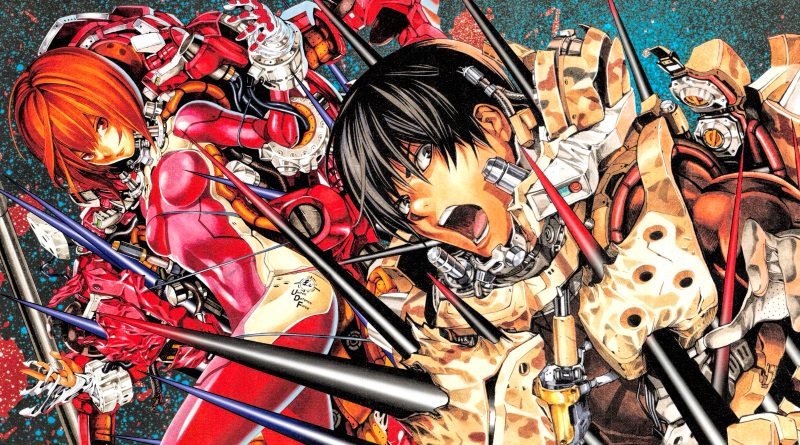
When I watch All You Need Is Kill, it is almost impossible not to notice its obvious similarities with other audiovisual productions. And if Edge of Tomorrow is the first one that comes to mind, that reaction is more than justified. The original novel by Hiroshi Sakurazaka, which this animated film adapts for the big screen, also served as the inspiration for the 2014 movie starring Tom Cruise and Emily Blunt.
The premise is fairly simple. A gigantic alien tree called Darol appears in Japan and begins spreading its trunks and roots in every direction. Humanity responds by organizing itself around this strange being, eventually creating a routine of exploration, research, and containment.
It is within this context that I meet Rita, a lonely and introspective girl who is part of the task force responsible for activities surrounding the extraterrestrial tree. But what initially seems like a controlled situation soon becomes a desperate fight for survival when violent creatures begin to appear, destroying everything and everyone in their path.
Rita then finds herself trapped in a time loop, forced to relive the same day over and over again every time she is killed by the aliens.
A Visual Style That Refuses to Be Comfortable
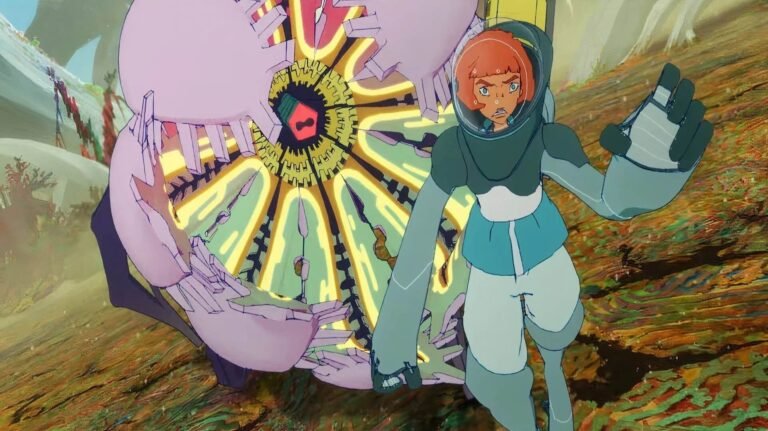
What immediately stands out to me in All You Need Is Kill is its visual style.
The film combines traditional 2D animation, with its familiar handcrafted feeling, expressive linework, detailed colors, and distinctive lighting, with the dimensionality of 3D animation. The result is an aesthetic that constantly plays with the viewer’s perception.
At several points, the movie alternates between these two visual languages. In others, it becomes a fascinating hybrid, almost challenging my eyes to understand what kind of animation I am actually looking at.
And that sense of visual strangeness feels completely intentional.
The character designs in All You Need Is Kill do not seem made to keep the audience comfortable. I rarely find soft curves, cute designs, or gentle expressions here. Instead, the film gives me broken, angular lines, unusual-looking characters, and a color palette that sometimes borders on the psychedelic.
In terms of visual representation, this may actually be the best possible way to approach the world portrayed in the film, and especially its characters.
This is a diverse, plural, futuristic world, but it is also an emotionally broken one. So it makes sense that it is inhabited by broken people.
Rita, Trauma, and the Weight of a Life Without Purpose
At one point in the film, I hear a small fragment of conversation between two characters who are not especially important to the plot. One of them mentions dealing with the emotional wound of being abandoned by their father.
That brief moment says a lot about the emotional atmosphere of the movie.
Rita herself is displaced, melancholic, and deeply traumatized by her mother’s rejection, a wound that led to a serious childhood incident that almost ended tragically for both of them. She moves through life without direction, feeling the boredom of routine and the heavy burden of an existence without real purpose.
That is why there is something deeply ironic about the arrival of the cosmic tree, and later the alien attack. These events violently disrupt the ordinary world Rita is trapped in. Yet her experience of reliving the same day again and again becomes an existential metaphor for the monotonous, captive life she was already living before the invasion.
In other words, the time loop is not just a sci-fi device. It becomes a reflection of Rita’s emotional state.
She was already trapped long before the aliens arrived.
Repetition, Survival, and the Arrival of Keiji
Psychology often teaches us that repeating the same behavior while expecting different results is a mistake. That idea seems to fall directly onto Rita after her many failed attempts to escape the time loop.
Eventually, she realizes that she is being watched — something completely new in the repeated cycle of her days. That discovery leads her to Keiji, a young man trapped in the same situation.
From that point on, the film gains a very interesting dynamic.
On one hand, there is the interaction between two characters who are extremely different in how they deal with life. On the other, there is the action itself, which becomes more inventive and intense through Keiji’s presence.
His intelligence and talent for technological inventions create stylized, colorful, fast-paced action scenes. At times, they are almost difficult to follow, but that chaotic energy feels consistent with the film’s visual identity.
At the same time, Keiji’s kindness, innocence, lightness, and even the way he reflects his own traumas create a strong emotional counterpoint to Rita.
He does not erase her pain. He does not magically fix her. But his presence gives the story a different rhythm, one where survival is no longer only an individual burden.
An Animated Film With the Soul of a Live-Action Drama
In the end, All You Need Is Kill feels like an animated film heavily influenced by live action, especially drama.
I can feel that in the fluid camera movement, the silent and contemplative shots, the pauses that allow the characters to breathe and absorb what is happening, and the way the film clearly positions itself as an emotional journey rather than just a sci-fi action spectacle.
The soundtrack also reinforces this feeling. Its epic, emotional use of strings often rises at key moments, helping to create scenes of genuine beauty.
But above all, the film gives me the impression of being a strangely captivating and artistic sci-fi fable.
It is a story about resisting the monotony and hopelessness of difficult days. It is about discovering that support and identification can come from the most unlikely people. And it is about learning to look at life with a little more goodwill, openness, and collective spirit.
All You Need Is Kill may be strange, sharp-edged, and visually uncomfortable, but that is exactly what makes it feel alive. Beneath its alien invasions, time loops, and explosive action, I find a deeply human story about trauma, resilience, and the quiet possibility of connection.







Laisser un commentaire